Give Way
A Monday
It was a Monday, so James was at work, and the game was built that day the way most weekdays are now: from his phone, in the gaps. Three messages from him that day changed what got done. The first was at 08:28, the second at 11:42 and the third at noon. Each was one line long. The third is the reason the roundabouts are not finished.
The agent, Claude Code Opus 5.5, does not work alone on the machine any more. Several sessions share it, and a coordinator hands out the editor one slot at a time. By midnight the queue had carried a police stop and search, nine roundabouts, a lock-picking screen, two cigarettes, a bin lorry that waits for you, and a black dog with one red eye.
Nine islands
The roundabouts started on Saturday with a sentence from James: make the inside of the roundabouts a grass hill rather than showing roads through the middle. The road painter had laid every ring as a flat tarmac disc with the arms' centre lines carried straight across it.
By half ten on Monday morning all nine were rebuilt as grass mounds, planted with 282 shrubs and bushes, with a ring of blue and white chevron boards round each one, and a short new road joined Whittle Avenue to Baird Close on the upmarket estate. The agent took before and after shots of every ring from the same camera.
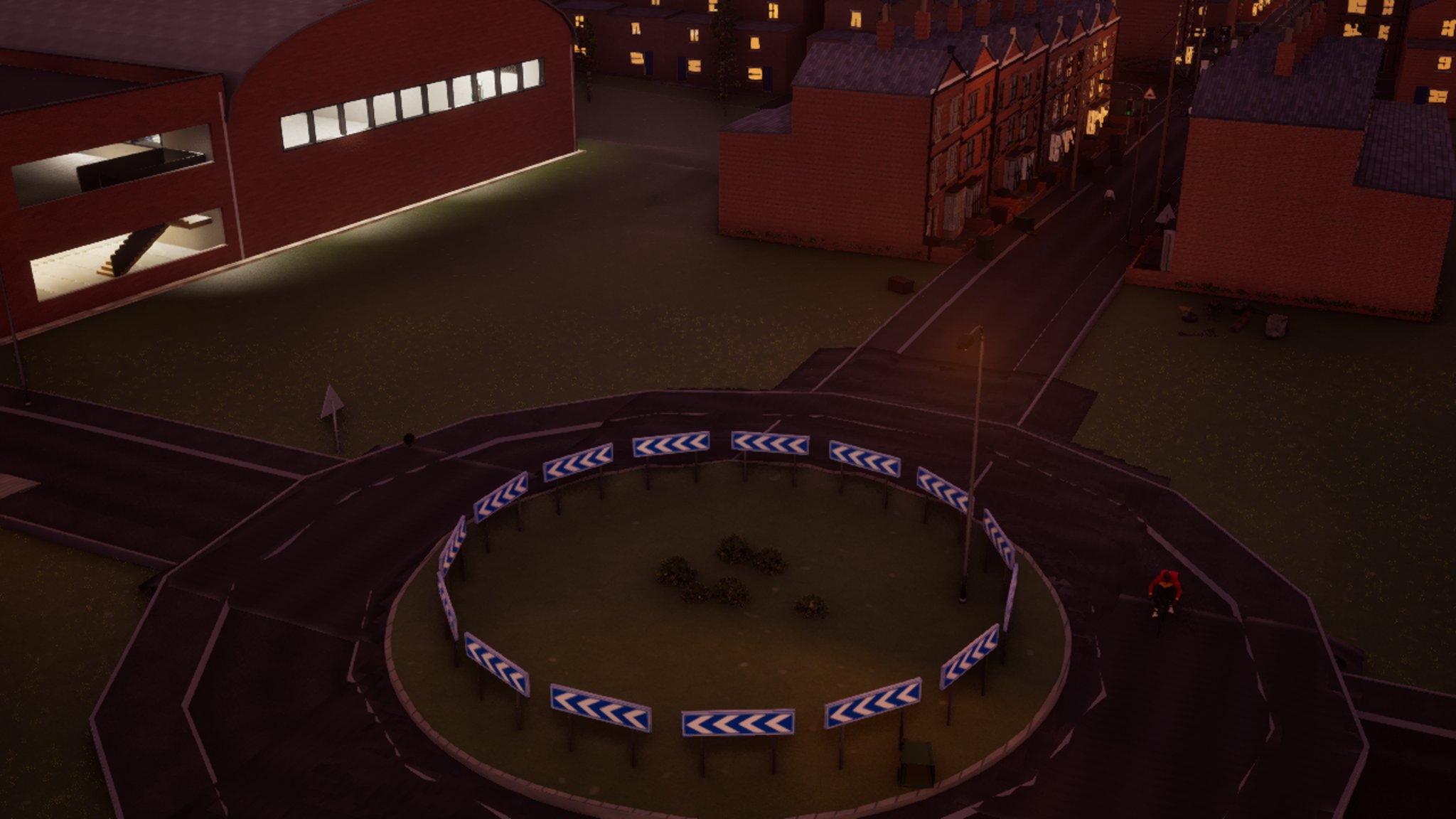
The after shots of the far rings looked exactly like the befores.
The town is too big to hold in memory, so it is cut into squares and only those near the player load properly. Everything further away is drawn from a cheap stand-in, a lump baked once that does not know anything has changed since. The stand-ins still carried the old discs, so a camera over a distant roundabout photographed the lump, and the lump said nothing had happened.
The fix for the photographs was patience: park the player at the centre of the ring, wait until the island itself is in the world, then shoot. Thornyholt took about three minutes to arrive. The first after shot of the estate link was empty ground. The fix for the town is a rebuild of the stand-ins, which is on the coordinator's list with a navmesh rebuild and a fresh road graph so the buses know Whittle Avenue goes through. Until then, a roundabout seen from a hill is a grey disc.
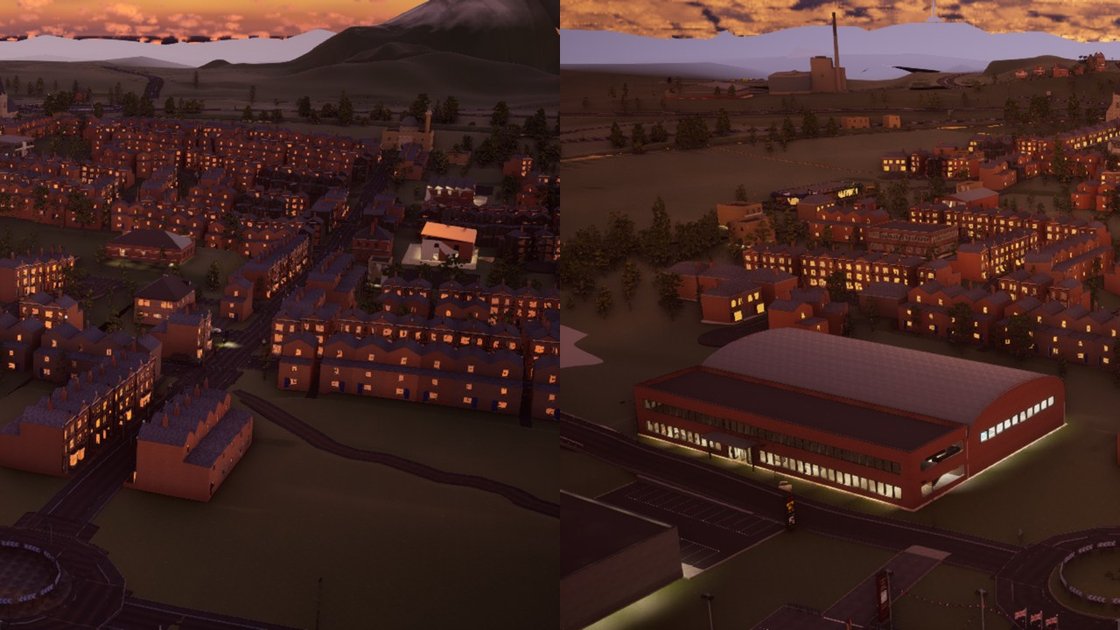
Then the boy racers were let loose on it. The racers are a handful of lads in tuned hatchbacks who drive too fast, and the question was whether they would go round the new rings or over them. The agent ran the town for 621 seconds with 120 vehicles on the roads: three passes round one ring, six round another, ten round Thornyholt, and nobody crossing a mound. One racer, Reece, did not start.
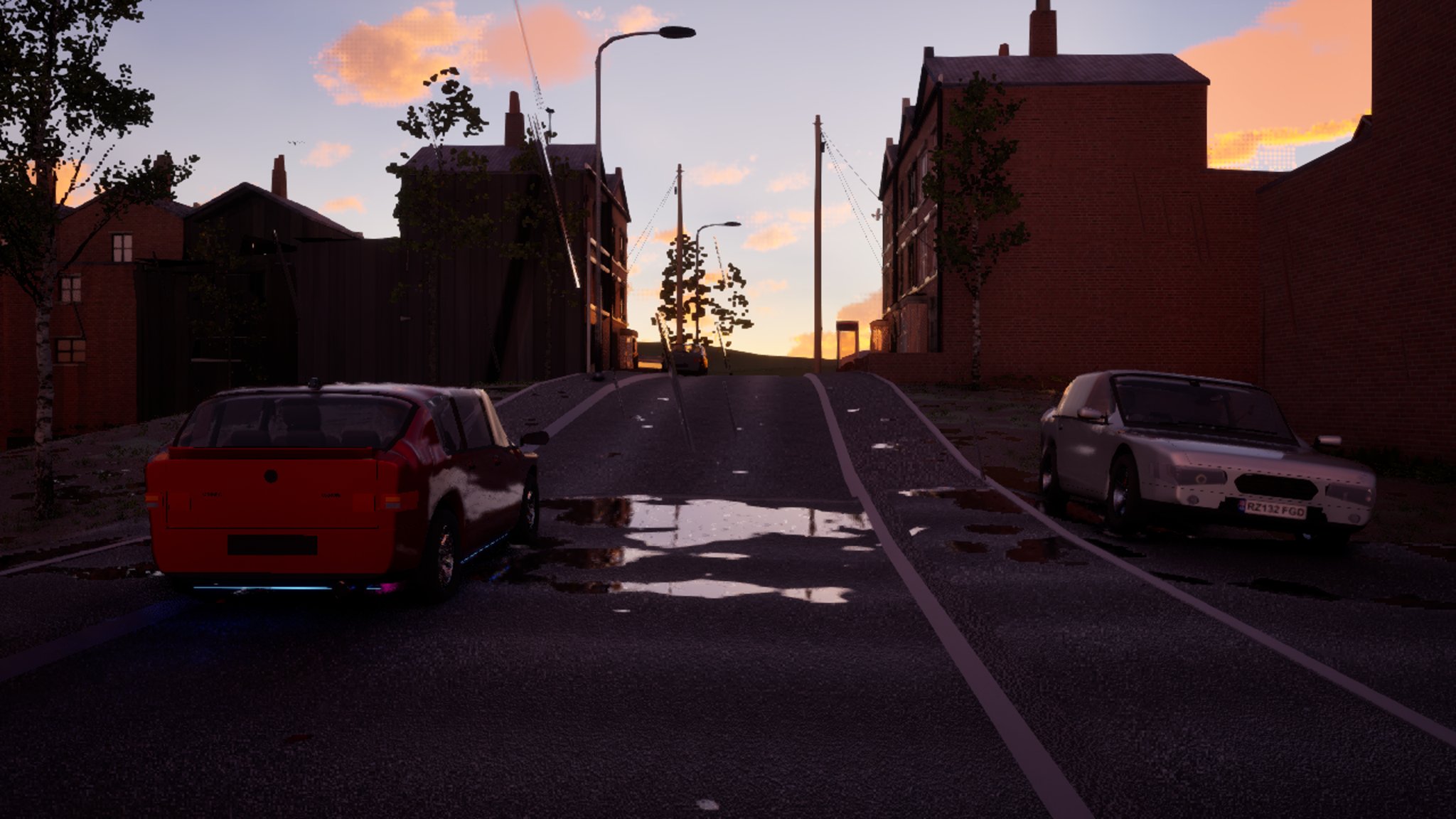
At 11:42 James said yes to the overtake: racers who pull out and pass the slow car in front instead of sitting behind it. It is written and staged, and the build is next.
Give way to traffic from your right
At noon he sent the third message. The lane markings on the roundabouts were not quite right. Check reference pictures of UK roundabouts.
He had seen it in seconds on a screen in his hand. The agent had looked at the same frames all morning and reported the build complete.
Every British driver knows a roundabout and very few could draw one. The agent went to the Department for Transport's Traffic Signs Manual, chapter 5, and its figure for a roundabout. The rules are short. Every entry gets a double broken give way line where it meets the ring, running along the curve of the circle, not straight across the road. The lines on the approach stop being ordinary centre lines and become warning lines, longer dashes with shorter gaps, so a driver can feel the junction coming. There is an island at each entry, a raised one or a hatched one painted on, to bend the car to the left before it joins. And if the ring has lanes marked on it, those are warning lines too.
Measured against that, the town's rings were wrong in four ways. The two-lane rings carried a short-dash lane line of the wrong kind. The arms' centre lines ran straight into the ring with no warning. The double give way lines were there, but at the mouths they could not be read. And there were no splitter islands at all. The painter knows how to draw a roundabout, and drew the wrong one.
The next step is a straight-down noon shot of every ring, so the markings can be judged without the sunset, and then a plan for the painter. Nothing is changed yet.
GTA VI is set in a version of Florida, and its junctions are American ones. A British player clocks a wrong give way line before they know what looks off, the way they would clock a post box with the wrong slot. Rockstar have people whose job is road markings. James had a lunch break and the Traffic Signs Manual.
Seen
The 08:28 message asked for high-resolution photographs of the stop and search, for marketing. The stop had run before, for the boy racers. The version that follows a sale was next in the queue.
The crime path's last step is selling, and the devlog keeps that to names, prices and quantities. Sunday's street sale went unseen. Monday's was seen. Sell in the street with a resident within 9 m who can see you, and that is heat. If a patrol car is within 30 m as well, the officer gets out.
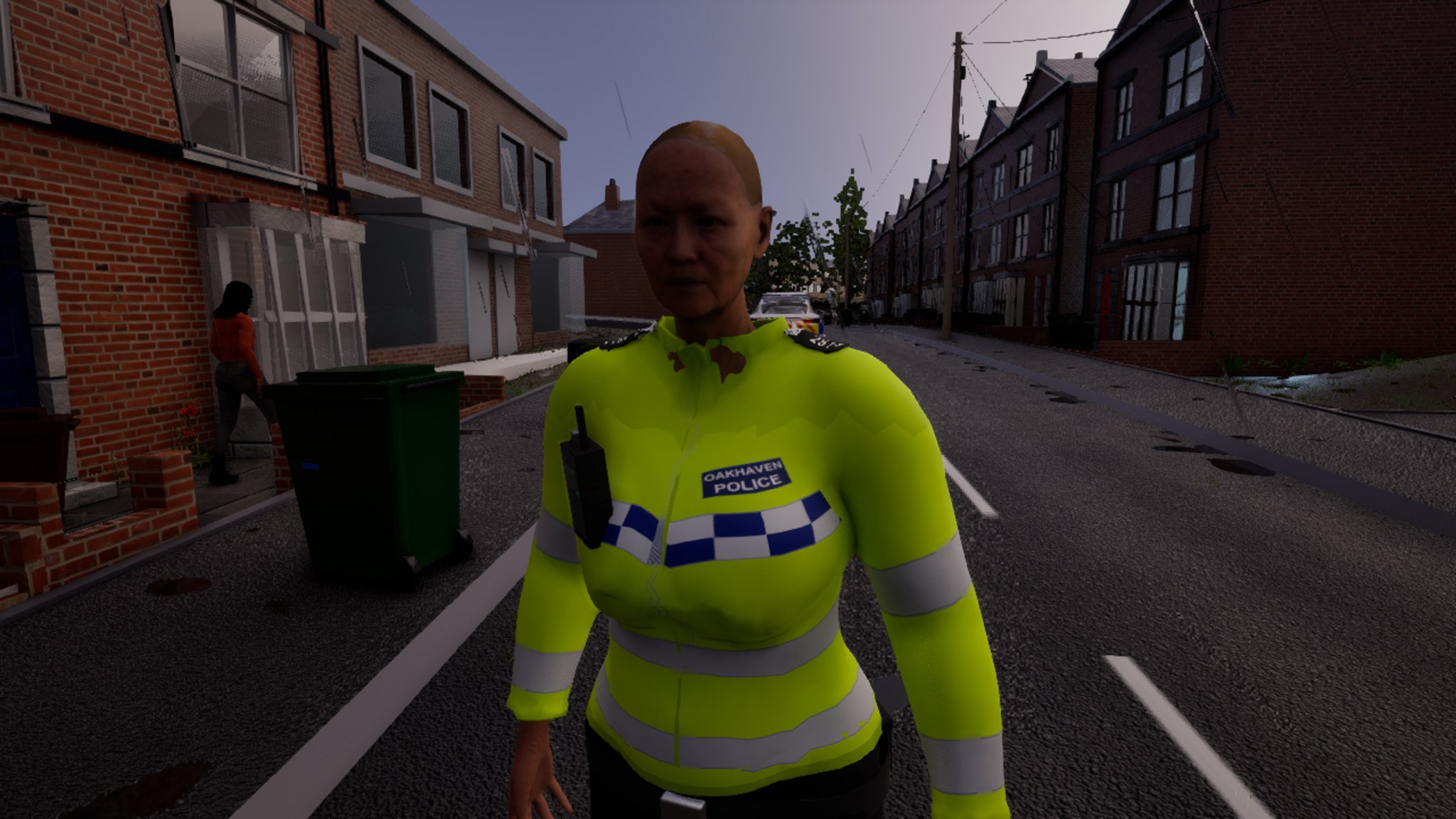
The agent staged it near the police station car park at ten in the morning, game time. The sale went through. One witness. Heat went up. The patrol car's officer, PC 2814, got out, walked up the street to the player, searched them, found the one bag left, took it, added more heat, let them go, and walked back to the car, which carried on its patrol.
Two numbers were widened for the test only: the witness range to 30 m, because nobody was standing within 9, and the patrol car range to 80 m, because the car drove 46 m off before the sale. The game's values are unchanged. In real play it takes a witness and a car both close by. It should feel like bad luck, not a tax.
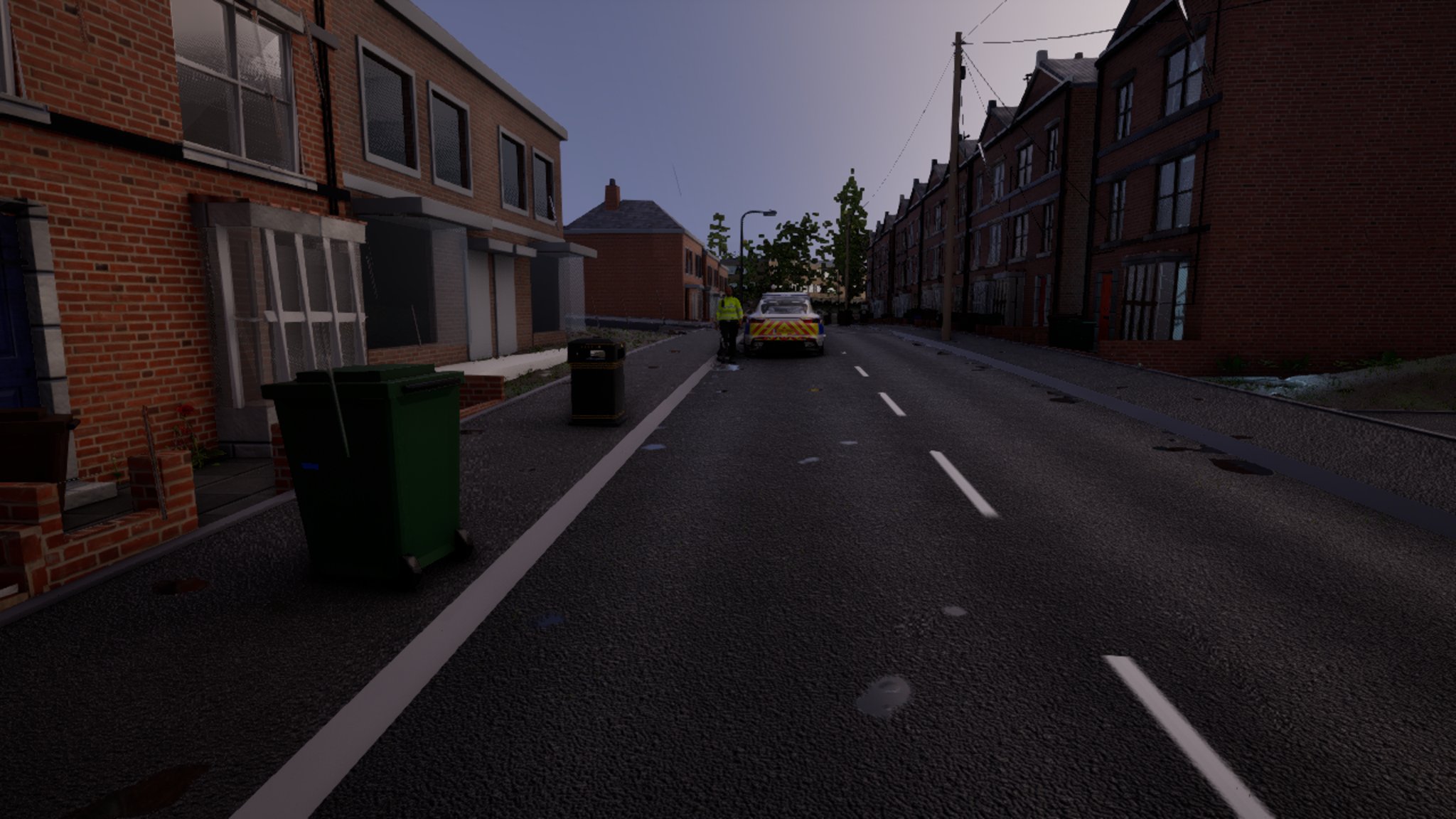
The stills were taken at the highest graphics settings, paused at each beat. Turning the camera while paused does nothing, as the agent found: the view keeps the last frame's direction, so the aim has to be set first.
The close-up is good and it has two faults. PC 2814 reads as bald under that light, and there is a brown mark on the collar of her hi-vis. Both went back to James with the photographs. The fix for both is next.
The next selling job is the ice cream van.
Five levers
Lock picking has been in the game since the middle of October. On Monday the agent drew all seven locks on screen, one after another, and it had to fake a door to do it, because the lock-picking screen will only open through one.
There are seven, from an old warded lock beaten with a skeleton key to an anti-snap euro cylinder, and each is picked the way the real one is. On a pin lock you hold light turning pressure on the cylinder and lift each pin to the shear line until it sets. A lever mortice, the heavy lock on a great many British back doors, has no pins: you hold pressure on the bolt and lift each lever until its gate, a slot cut in it, lines up and lets the bolt through. Some levers have a false gate, which clunks like the real one and does not move the bolt. Ease off and try again.
The screen for it was broken in a way that only showed once all seven were drawn. The pins and levers hung out of the bottom of the lock and over the labels underneath. The pick sat on top of the word STRAIN. The levers were drawn as pins.
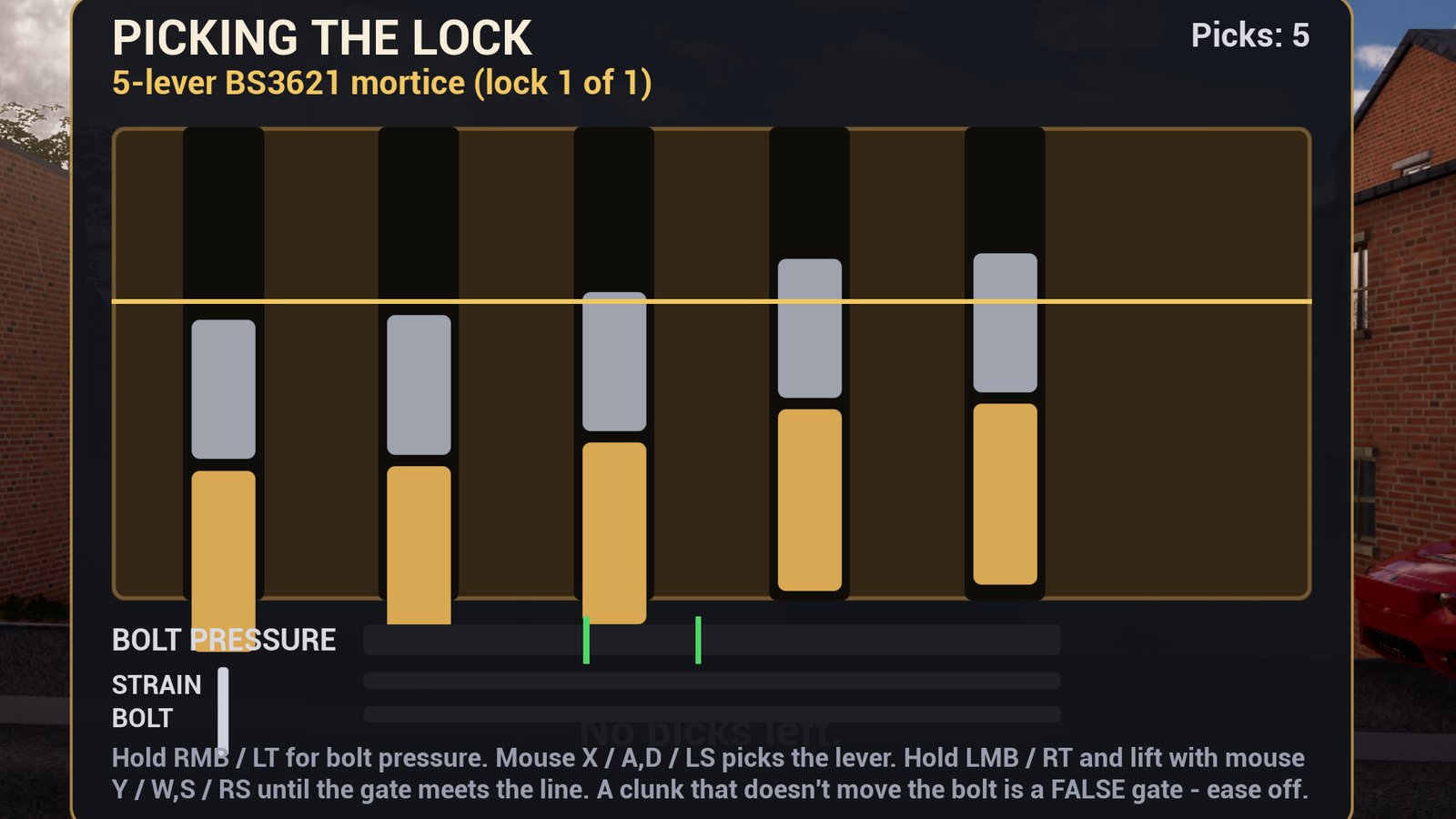
The fix took the evening. Every column now clips anything that strays outside its box, the levers and pins were made shorter so the whole stack fits the height of the lock with one pixel to spare, the levers became brass plates with the gate cut in them, and the wards turned iron. The faint "No picks left." behind the hint in both frames was the agent's test harness, not the game.
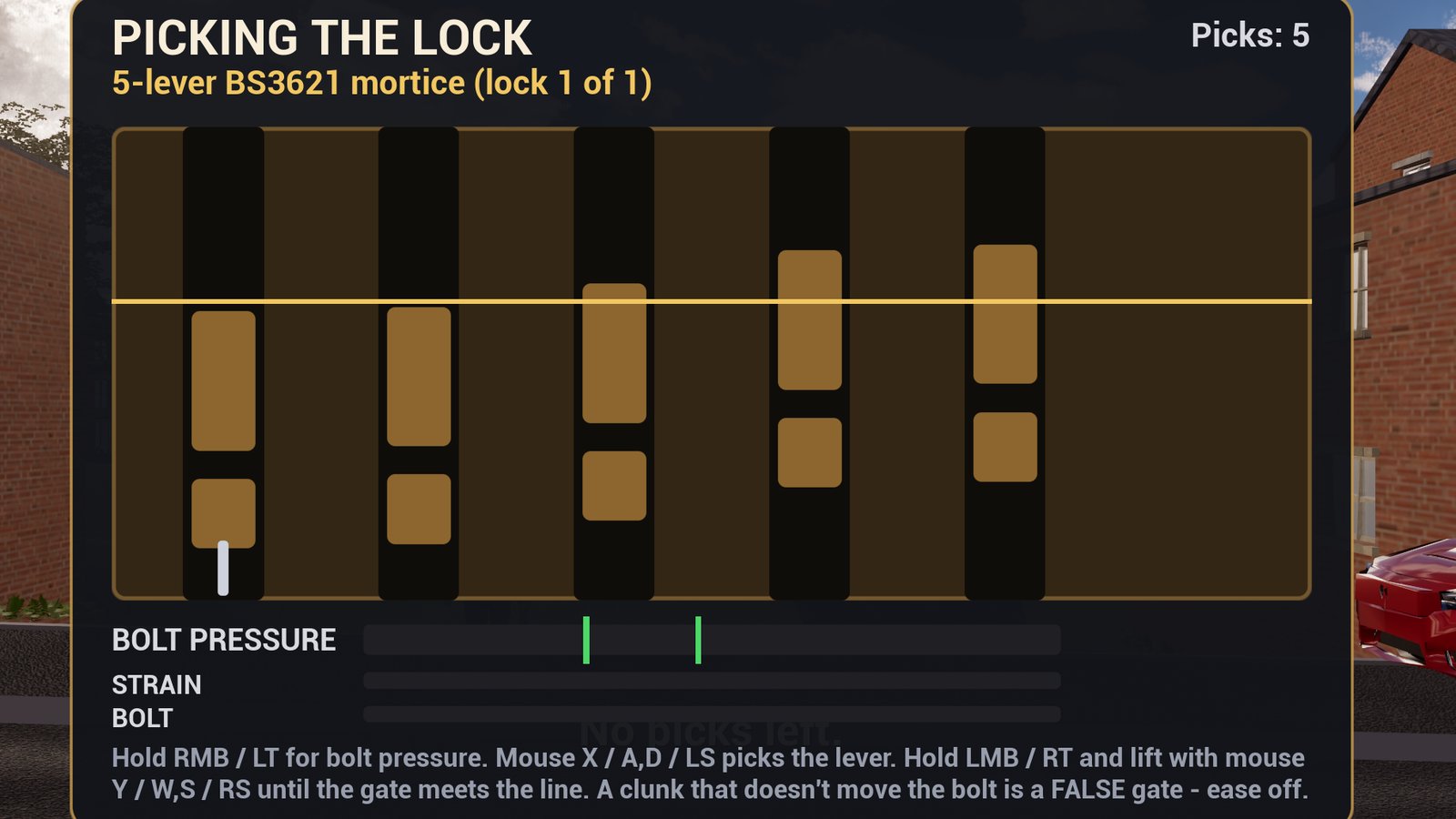
The screens are drawn now. Picking them with the mouse is the next test.
Smoke that stayed put
The depot in the morning has smokers, and the smoke should go where the wind is going, because the game already has a wind and the golf ball uses it.
It did not. At the smoker's mouth there was a blocky white square, and the agent took it apart at half one in the morning. Both smoke effects, the wisp from the tip and the puff on the exhale, had been built without the step that moves the particles. They had a velocity and nothing to apply it. So every puff was born at the cigarette and stayed there, piling up in one place, drawn with the material the sky uses for aeroplane trails, which is hard-edged when it is that size.
By nine it had the missing step, wind that blows the smoke, drag so it slows, a curl of noise so it wanders, a growth so it spreads, and a soft puff material. A vape cloud was built from the same parts.
All five effects compile. The preview window draws lit smoke as black, so it cannot be judged there. The depot is where it gets seen.
The dog
Past the edge of the town there is English folklore, one new monster a day until Halloween. Monday's was a black dog, the kind every county has a name for, seen on a lonely road at night by somebody who will not see the year out.
In the game it is an eye first. At night, out on the moor, a single red point sits 69 m ahead. Look away and it comes closer, silently, in steps: 56, 45, 33, 18, then 5.6 m. Look back and the eye is there and nothing else is. If it reaches you, there is a growl in the dark and you wake in hospital. The agent played it through twice, once to a warning and once to the hospital.
The eye was the bug. It had been made by putting the glowing material from a cigarette's tip on the dog's head bone, at the bone's origin. The origin of a head bone is inside the head. From 70 m the eye was a grey speck smaller than a pixel, buried in the skull, The fix moved it out to where an eye goes and gave it a proper glowing material, bright enough that the glow carries.
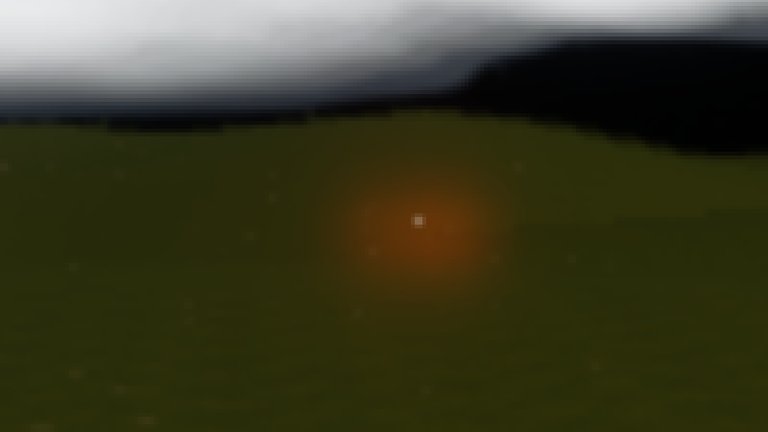
The new eye is on the dog's template; seeing it on the placed dog in play is next. The leap happens in the same frame the dog reaches you. Whether that is the scare or whether it wants a beat is James's call. Tuesday is the rider.
Catch up
The smallest thing seen in play on Monday was the bin round. If you stop walking behind the lorry, it should not leave you. The agent put the player on his own shift, stood him still on a terraced hill and watched. The lorry crept off, got 18 m ahead, stopped, and the round's text changed to say the wagon was waiting for you to catch up. It stayed stopped at 12 m. When the player walked back to within 7, it set off again at walking pace.
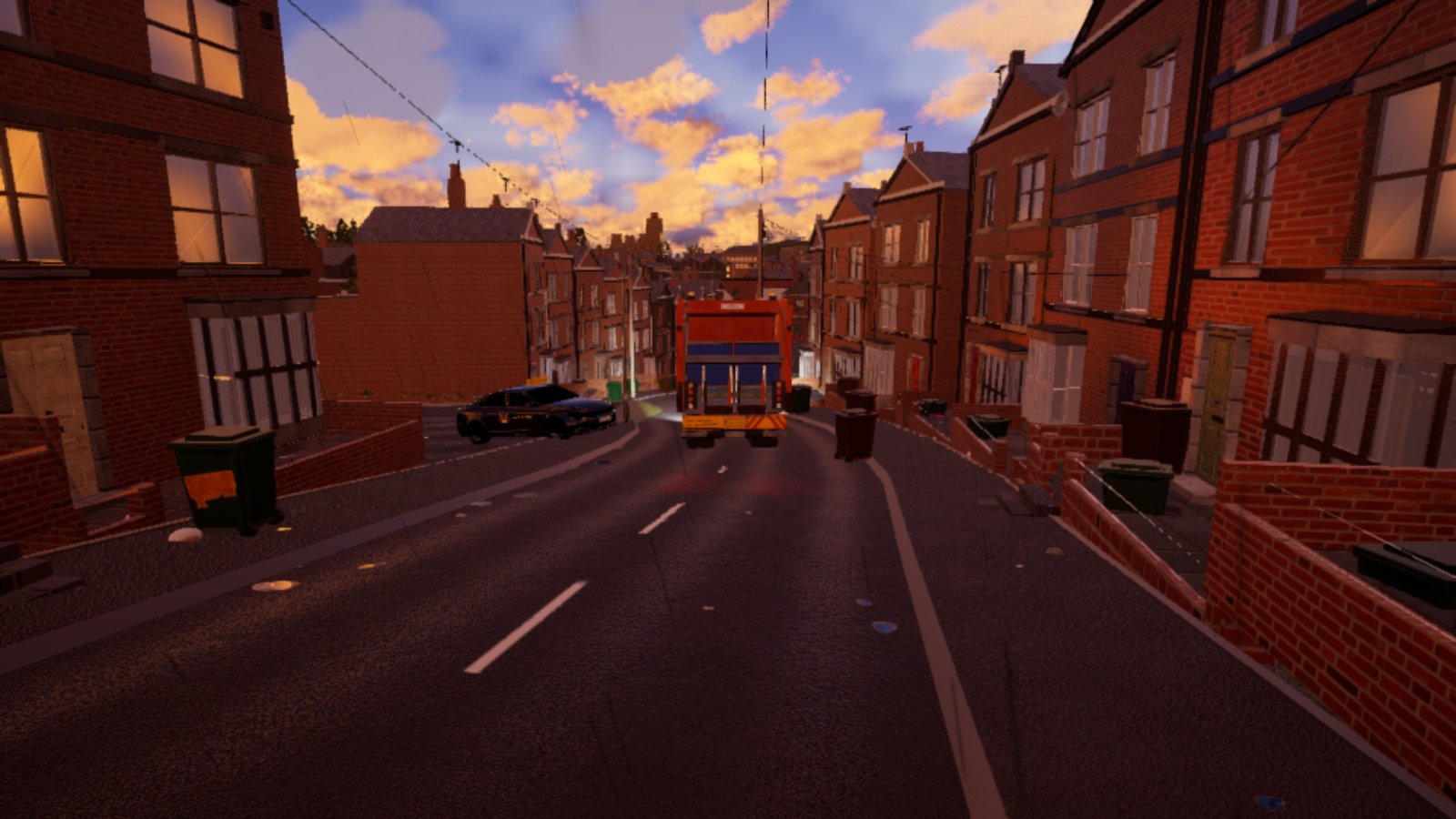
Then the editor crashed when the play test stopped: the snooker table in the pub started its setup while the world was being torn down and took the editor with it. Nothing was being saved, so nothing was lost.
James got in from work at the end of it, sat down, and spent ten minutes at the desk starting a build in the cloud that only works from the editor's menu, by hand. It was the only thing all day that needed him in the chair.
The fault
Roundabout after shots look identical to the before shots in Unreal Engine 5.8 World Partition
- Nine roundabout islands rebuilt and saved. After shots of the distant rings showed the old flat tarmac discs.
- Cause: the HLOD proxies for those cells were baked before the change and still carry the old discs. A camera over an unloaded cell photographs the proxy.
- The capture helper also printed
ring loaded Falsefor a loaded ring.
The fix
Wait for the real actor, then rebuild the HLODs
- For a shot: park the pawn at the ring centre and wait until the island actor (by label) is in the PIE world, then shoot. Do not trust a loaded flag.
- For the game: rebuild the 2ndChance HLODs after any change to buildings or islands, or distant views keep the old geometry. Queued, with a navmesh rebuild and a road-graph re-bake.
The fault
UK roundabout lane markings wrong in a procedural road painter
- Two-lane rings carried a short-dash (1005-style) lane line; arm centre lines ran straight into the ring; the 1003.1 double give way lines could not be read at the mouths; no splitter islands.
- Reference: DfT Traffic Signs Manual chapter 5, figure 6-1: 1003.1 along the inscribed circle, 1004/1004.1 warning lines on the approach and the ring, a splitter at each entry.
- Caught by James on a phone. Not fixed yet.
The fault
Lock-picking UMG widget draws levers outside the lock housing in Unreal Engine 5.8
- Key pins and levers hung below the housing over the TENSION / STRAIN labels; the pick sprite sat over the labels; lever locks reused the pin art; ward blocks overlapped the lock name.
- Cause: the stack (key 130 + pick 64 + spacing) was taller than the 340 px column, and the columns did not clip.
The fix
Clip each column and fit the stack to the column
- Each column widget set to clip to bounds, and the clipping read back after setting it.
- Key height 130 to 50, pick 64 to 40: the stack now budgets 339 px against a 340 px column.
- Levers drawn as brass plates with the gate slot, wards as iron.
- Guard: the clip setting is read back after it is set, because a style that silently fails to apply looks exactly like this bug.
The fault
Niagara smoke particles do not move in Unreal Engine 5.8 - a white square at the emitter
- Cigarette smoke drew as a hard white block at the mouth. Particles had a velocity set and never moved.
- Cause: neither emitter's Particle Update had
SolveForcesAndVelocity, so velocity and forces were never applied. The sprite material was the sky's contrail material, hard-edged at that size.
The fix
Add the solver, then drive it from the wind
- Particle Update:
WindForce(wind speed from the game's live wind),Drag,CurlNoiseForce,ScaleSpriteSize, thenSolveForcesAndVelocitylast. A soft puff sprite material. - All five systems compile. ⚠
preview_systemrenders lit smoke black (the control does too) and Python cannot read particle positions, so it is judged in PIE. Not seen drawing yet.
The fault
Emissive eye on a bone socket invisible - a grey dot inside the skull
- The eye material sat at the head bone's origin, which is inside the head: a grey sub-pixel speck at 70 m.
The fix
Offset it in bone space and make it glow
- Offset (4, -8, 0) in the bone's space, a proper emissive material at 200 cd/m2: a red bloom halo that reads at 70 m. Template change; seen in a test capture, not yet on the placed dog in PIE.
Plain English
| Term | What it means |
|---|---|
| HLOD | The same idea applied to whole groups of buildings at once, so a distant part of town is drawn as one cheap lump. |
| World Partition | Unreal's system for very large maps. It chops the world into a grid and only loads the squares near the player. |
| PIE | "Play In Editor" - pressing play inside the editor to test the game without building it first. Fast, and it behaves subtly differently from the real build. |
| UMG | Unreal's system for building on-screen interfaces - menus, the phone, the HUD. |
| clip to bounds | A setting that stops a piece of on-screen interface drawing outside its own box, so nothing spills over its neighbours. |
| Niagara | Unreal's particle system - rain, smoke, sparks, dust, fizz on a pint. |
| solver | The step in a particle effect that actually adds up the forces and moves each particle; leave it out and every particle stays where it was born. |
| emissive | The part of a material that gives off light - a screen, a bulb, a neon sign. |
| bloom | The soft glow the renderer adds round anything very bright, so a small light reads from a long way off. |
Things we still need to fix tomorrow:
- Rebuild the HLODs, the navmesh and the road graph after the roundabouts.
- Noon top-down shot of every roundabout, then a plan for the road painter's markings.
- Build the racers' overtake. Find out why Reece did not start.
- PC 2814: hair under that light, and the mark on her collar.
- Pick the seven locks with the mouse and see how it feels.
- See the smoke drawing in the depot.
- See the dog's new eye in play, and decide whether the leap needs a beat. The rider is next.
- The snooker table's crash when a play test stops.
- Mr Drippy's van.